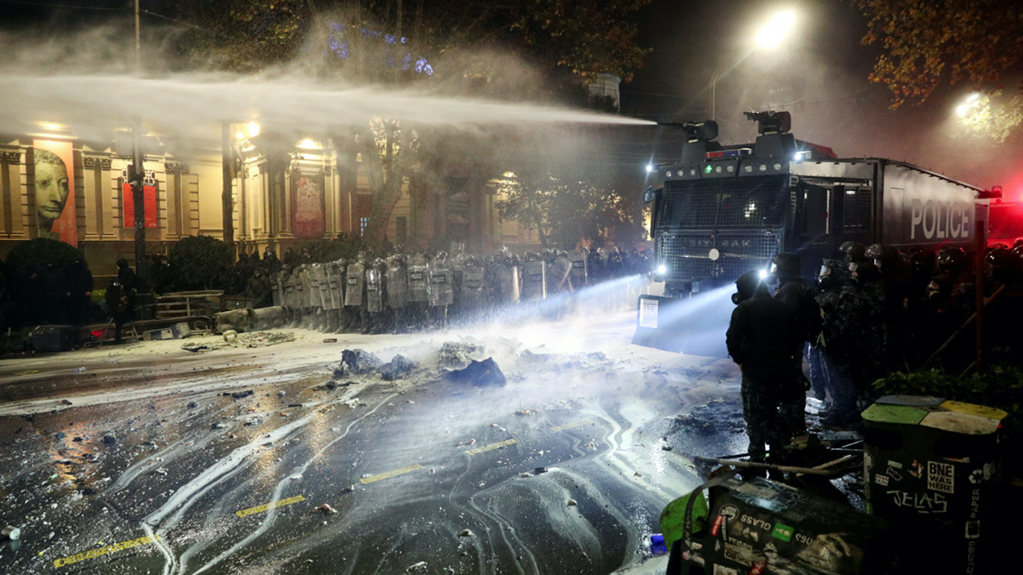
Georgian non-governmental organisations are calling for a public inquiry into which chemical substances the police used against peaceful protests in November-December 2024.
News
According to a joint statement by NGOs, a journalistic investigation prepared by the BBC “contains shocking reports of the use of banned chemical weapons by Ivanishvili’s police against the Georgian people.”
“Violent crimes committed by the regime’s Ministry of Internal Affairs’ forces against peaceful protesters during the events of November-December 2024 remain uninvestigated to this day. Not only has no one been punished for these crimes, but Ivanishvili's Prime Minister, Kobakhidze, has profusely thanked the perpetrators of these offences. Among them are the then Minister of Internal Affairs and other high-ranking officials sanctioned by the US and UK for serious human rights violations. Moreover, Ivanishvili’s President has even awarded 11 of them with the Order of Honour.
Georgian Dream’s cynical attitude towards its own population is not something new; however, in the BBC film “When Water Burns,” the facts and evidence presented are shocking. According to the film’s investigative journalists, in November-December 2024, the regime allegedly used the chemical substance bromobenzyl cyanide by mixing it with water cannon against peaceful demonstrators. This substance was first used during World War I, and after the 1930s, its use was prohibited. Compared to “tear gas,” this is a much more harmful agent and can have long-lasting effects on a person’s health.
Using chemical substances against the large crowds of people clearly violates international norms and standards in the field of human rights. Therefore, it can be assessed as an example of torture, inhuman or degrading treatment,” it is stated in the statement.
NGOs highlight that a special report was prepared by the investigative journalists' team of “Nodar Meladze’s Saturday” concerning serious violations committed by the Ministry of Internal Affairs in November-December 2024. Additionally, the Georgian Young Lawyers Association and other partner NGOs outlined the same issue in their report, “Human Rights Crisis in Georgia After the 2024 Parliamentary Elections.”
“Despite numerous requests, it has been a year since the Ministry of Internal Affairs refused to disclose which substances were used for “tear gas” and water cannons.
However, following the BBC film release, along with serious human rights violations, another legal issue also arises on the agenda. Particularly, it needs to be determined if the chemical substance bromobenzyl cyanide used against peaceful demonstrators is a prohibited action by the International Convention “On Chemical Weapons.”
In recent days, we will appeal to relevant international organisations and institutions to send experts to Georgia with the appropriate competence and qualifications to fully expose this criminal scheme.“
The statement is signed by:
- Rights Georgia
- The Georgian Center for Psychological and Medical Rehabilitation of Torture Crimes - GCRT
- Georgia's Association of Young Lawyers.
- European Foundation
- Civic idea
- EECMD
- Tolerance and Diversity Institute (TDI)
- Georgia's European Orbit
- Partnership for Human Rights
- Transparency International - Georgia
- Economic Policy Research Center
- Georgian Democracy Initiative (GDI)
- Safari
- Women's Initiatives Supporting Group
- Democracy Research Institute
- Tbilisi Pride
- Civil Movement for Freedom
- Human Rights Centre
- Georgia’s Future Academy
- Green alternative
- Democracy Defenders
- Europe-Georgia Institute
- International Society for Fair Elections and Democracy
- Social Justice Center
- Civil Society Foundation
The BBC gathered evidence suggesting that in 2024, the Georgian Dream party used WWI-era chemical weapons to disperse protests. The substance involved is bromobenzyl cyanide, which the French military called “camite.” The BBC investigative journalists obtained a copy of the Special Tasks Department's inventory, dated December 2019. Journalists discovered it contained two unnamed chemicals. These were listed as "Chemical liquid UN1710" and "Chemical powder UN3439", along with instructions for how they should be mixed.
According to the BBC, UN1710 stands for trichloroethylene (TCE), which allows other chemical compounds to dissolve in water. Christopher Holstege, Chief of Division of Medical Toxicology at the University of Virginia, explains that “Trichloroethylene easily penetrates the skin, lungs, and gastrointestinal tract. It impacts the nervous and cardiovascular systems, and it can also affect the liver.”
UN3439 was much harder to identify, as the BBC claims. It is an umbrella code for a whole range of industrial chemicals, all of which are hazardous. The only one of these that the BBC found to have ever been used as a riot-control agent is bromobenzyl cyanide.
“Based on the available evidence… the clinical findings reported by both those exposed and by other witnesses are consistent with bromobenzyl cyanide," said chemical weapons expert Christopher Holstege, and ruled out the likelihood of the symptoms being caused by more conventional crowd control measures, such as tear gas. According to the expert, the duration of the symptoms was not consistent with the effects of tear gas.
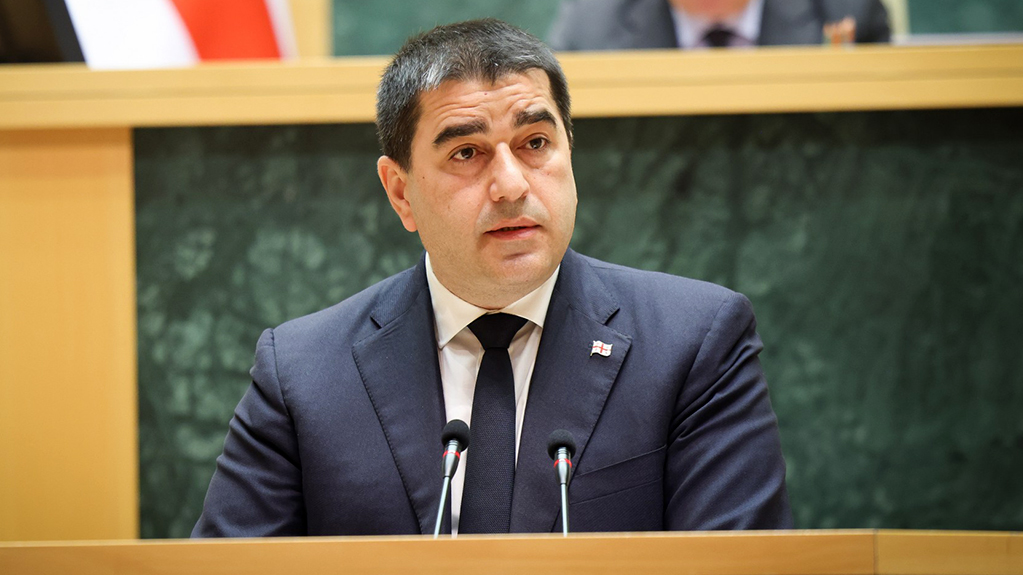
Today, Georgian Dream Minister of Internal Affairs Gela (Geka) Geladze announced that the accusation that the Ministry of Internal Affairs (MIA) used prohibited substances, so-called “camite” against demonstrators, is entirely absurd, a lie, and does not correspond to the truth. Moreover, he stated that MIA has never purchased the so-called “camite”. With this statement, he rejected the claim of his predecessor, Vakhtang Gomelauri, that the substances named by the BBC, “the Ministry of Internal Affairs (MIA) indeed purchased and used, but only until 2012.