
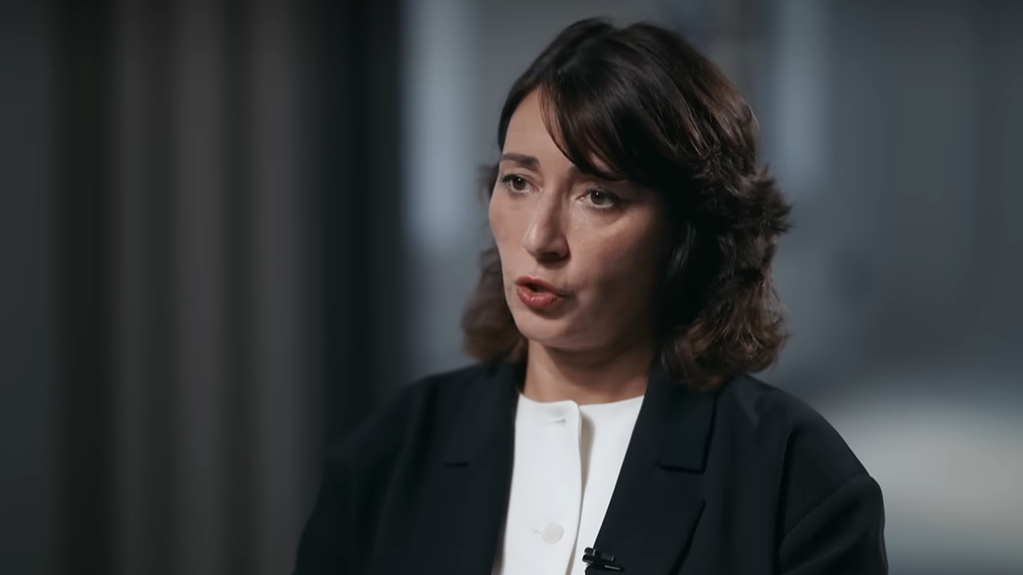
Eka Gigauri, Director of Transparency International Georgia, who is featured in a BBC journalistic investigation, was questioned by the State Security Service (SSS) in the presence of a magistrate judge.
News
According to Gigauri, she finds it incomprehensible why she was summoned by SSS, as what she said during the BBC interview is something she has publicly stated many times.
“The discussion was about whether I received payment for giving my comment. This was also an incomprehensible question for me. I once again spoke about what I think about the Georgian Dream," Eka Gigauri stated after leaving the Tbilisi City Court.
According to her, one of the questions was about how she learned that "camite" might have been used against the protesters, to which she replied that she learned from the article, "just like most of the Georgian population."
“They are doing all of this to cover up the alleged crime. The alleged crime is that a specific chemical agent was used against the Georgian people and demonstrators, which they themselves are not confirming. They can publish it themselves,” the Executive Director of “Transparency International – Georgia” noted.
Regarding the BBC's journalistic material, the State Security Service launched an investigation under Articles 333 and 319 of the Criminal Code, which concern abuse of official authority and assisting a foreign organisation in hostile activities.
As part of the investigation, doctors Gela Ghunashvili, Giorgi, Konstantine, and Davit Chakhunashvili were also summoned for questioning, whose research was included in the journalistic investigation.
Tamar Oniani, an employee of the Georgian Young Lawyers Association, was questioned in the presence of a magistrate judge. The human rights defender also gave an interview to the BBC.
Zviad Maisashvili, a participant in pro-European protests who was brutally assaulted by police on the night of 30 November 2024, has also been summoned for questioning. In the BBC film, he discusses the uninvestigated violence perpetrated against him.
The BBC managed to obtain a copy of the inventory from the Special Tasks Department, dated December 2019. Journalists found that it listed two unnamed chemicals, named “Chemical liquid UN1710” and “Chemical powder UN3439,” along with instructions for mixing.
UN1710 stands for trichloroethylene (TCE). It allows other chemical compounds to dissolve in water. UN3439 was much harder to identify since, as the BBC explains, it is an umbrella code for a whole range of industrial chemicals, all of which are hazardous. The only one of these that the BBC found to have ever been used as a riot-control agent is bromobenzyl cyanide.
After reviewing the BBC's evidence—medical research, witness statements, interviews with whistleblowers, and human rights reports—a leading expert in toxicology and chemical weapons, Professor Christopher Holstege of the University of Virginia, concluded that the substance used was bromobenzyl cyanide, also known as “camite.”
“Camite” was first used as a chemical weapon by French forces in World War I and was soon withdrawn from use because of the long-lasting effects of exposure.
The Georgian Dream government denies the BBC's information and warns of legal action against the British broadcaster.