

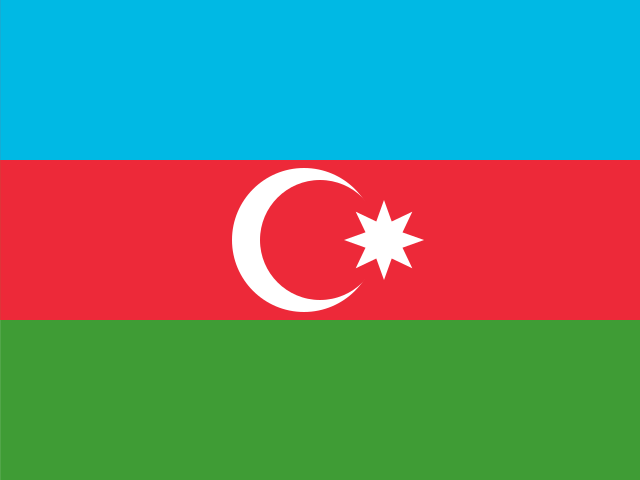

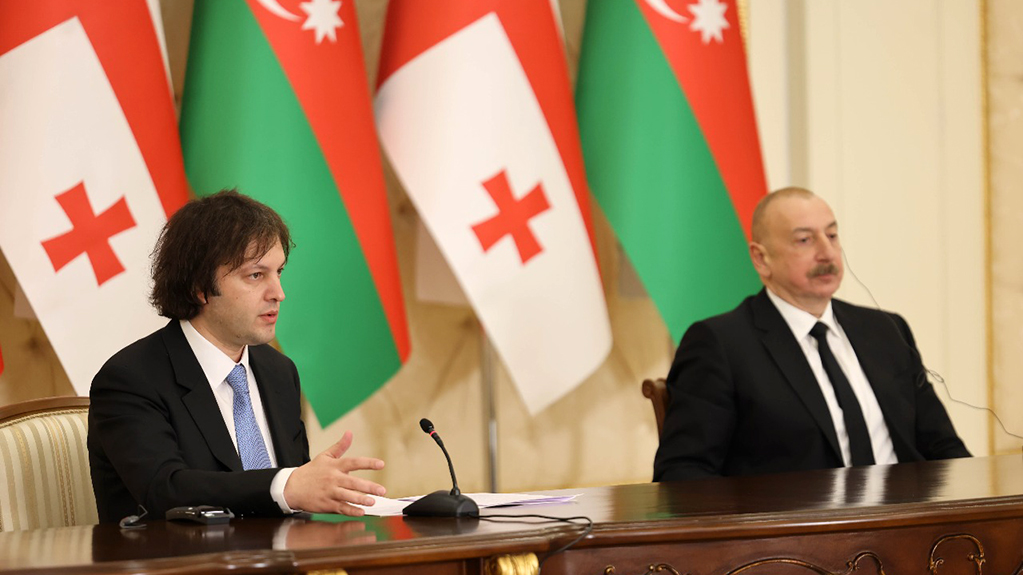
“Georgia is playing against peace: Tbilisi is testing the limits of Baku's patience,” the pro-government Azerbaijani media outlet Minval Politika published the article criticising the Georgian Dream Government.
News


The article states that “in recent months, a concerning change has been noticed in the relationship between Baku and Tbilisi,” which “is not the result of isolated bureaucratic shortcomings, but rather a series of decisions that reflect a shift in Georgia’s political logic.”
The media outlet states that although the situation on the Georgian border remains tense and Azerbaijani drivers have been subjected to systematic delays since September, the Georgian government has neither demonstrated the political will nor the administrative competence to resolve the issue.
Minval Politika notes that Tbilisi's recent move is even more surprising, considering the discussions on regional transport architecture.
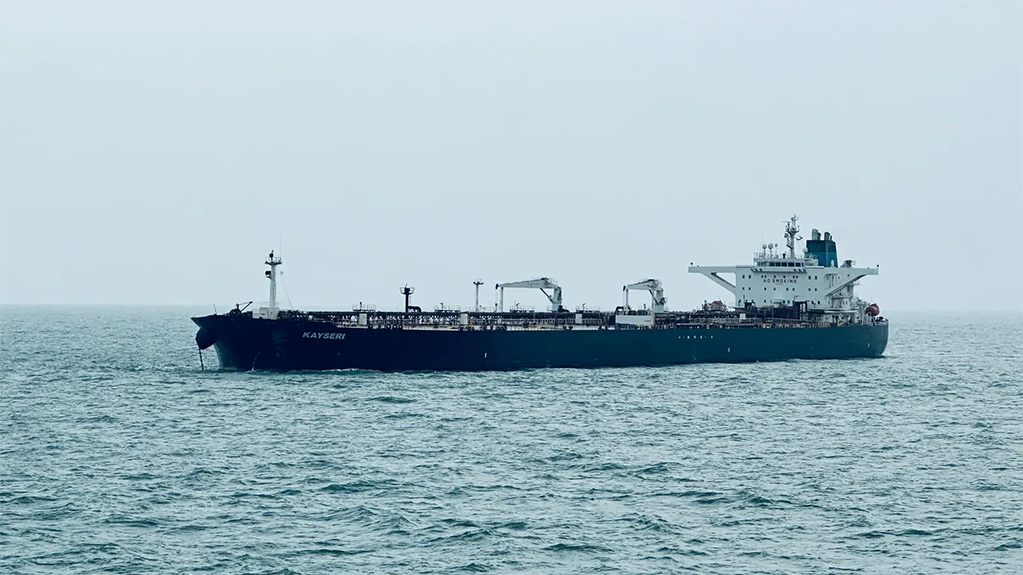
The Azerbaijani publication reports that on November 28, a week ago, the 12th meeting of the joint commissions on border delimitation between Azerbaijan and Armenia took place in the Azerbaijani city of Qabala. It was led by Vice Prime Ministers Shahin Mustafayev and Mher Grigoryan. The discussions covered technical issues and explored opportunities for economic cooperation. According to sources from Minval Politika, one key topic was the potential export of Azerbaijani oil and oil products to Armenia, described as “a project that can bring economic dividends to Baku and Yerevan and foster peaceful development in the region.”
“However, the absence of a direct rail connection between the two countries means that transit through Georgia is the only option. That is why Azerbaijan has requested that Tbilisi impose tariffs on the Gardabani-Sadakhlo section.
Georgia's response was a kind of indicator — not only of its commercial stance but also of its political thinking. Based on our data, the Georgian side proposed a tariff of $92 per tonne for the 111-kilometre section, which is $0.82 per tonne per kilometre! At first glance, this might seem like a standard tariff, but a comparison reveals the opposite.
For comparison, the transportation of similar cargo in Azerbaijan from Yalama station to Boyuk-Kiyasik station, 680 km away, is carried out at a rate of 17 USD, equivalent to 0.02 USD per ton per kilometre. This is 40 times lower than the proposed Georgian tariff. The 40-fold difference is an indicator of intent and the market.
Moreover, within Georgia, similar cargoes are shipped to the ports of Batumi, Poti, and Kulevi over a distance of 360–396 kilometres for $17, which equates to $0.04–0.05 per kilometre. In other words, when transit is favourable for Tbilisi, the tariff is 20 times lower than that offered for the route to Armenia. Here, economic logic gives way to political signalling,” the author of the article says, adding that such behaviour inevitably leads to confusion.
Minval Politika emphasises that Georgia, which relied on Azerbaijan's support during critical periods of recent history, is now displaying a pattern of behaviour that contradicts its own long-term interests – “not only because it undermines the trust of its main partner, but also because Georgia's current logistical monopoly is no longer irreplaceable.”
“Regional integration projects are developing, and attempts to preserve old architecture through forceful pressure only accelerate its erosion.
Today, Georgia is practically resisting the establishment of a sustainable regional peace architecture and mutually beneficial economic ties. At a time when the South Caucasus has a unique opportunity to shift from the logic of conflict to the logic of development, Tbilisi’s behaviour seems to be an attempt to hinder this transition process. It is difficult to call such a policy anything else: it not only undermines overall progress toward regional peace but also shows a lack of willingness to participate in creating a space of shared prosperity.
Tbilisi must understand that a policy of unjustified barriers inevitably leads to countermeasures. A country whose economy Baku has consistently invested in and supported for decades cannot disregard Azerbaijan's interests. Responsibility is the key indicator of a nation's maturity, and Georgia is currently undergoing this test.
The historical memory of the relationship between our countries is even more significant. During a period of intense tension between Georgia and Russia, Baku did not use Tbilisi’s vulnerability as a tool of pressure. It did not impose excessively high tariffs on Georgia, despite the country being in a deep crisis at the time and apparently willing to accept any conditions. Azerbaijan took a different approach — that of a partner, not one seeking profit. This raises a clear question today: how will Tbilisi respond to the current situation? Will it be content with silence and continue such actions in silence, or will it find the political maturity to openly recognise the problem and take a step towards cooperation rather than confrontation? “– writes the Azerbaijani media outlet.