



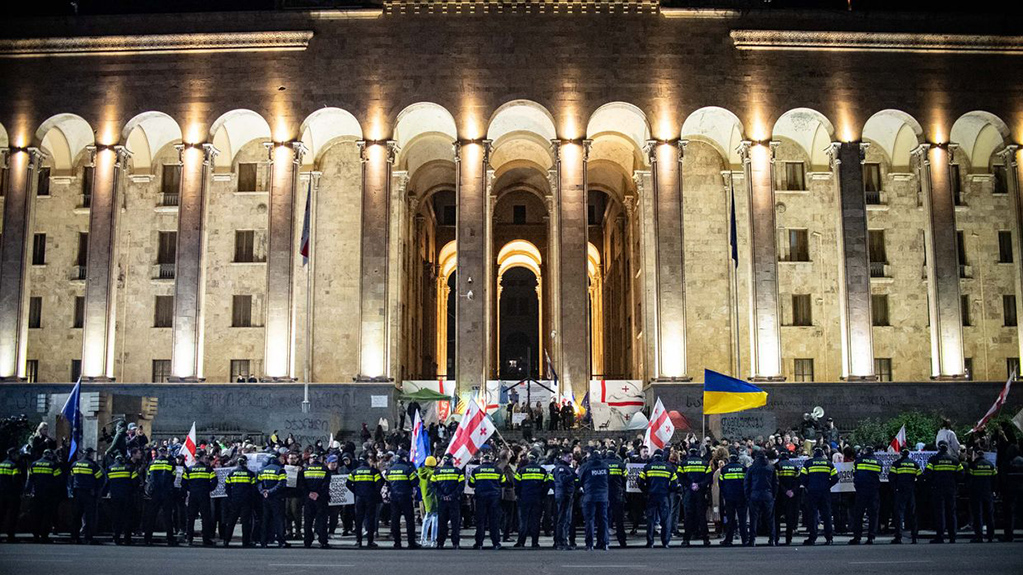
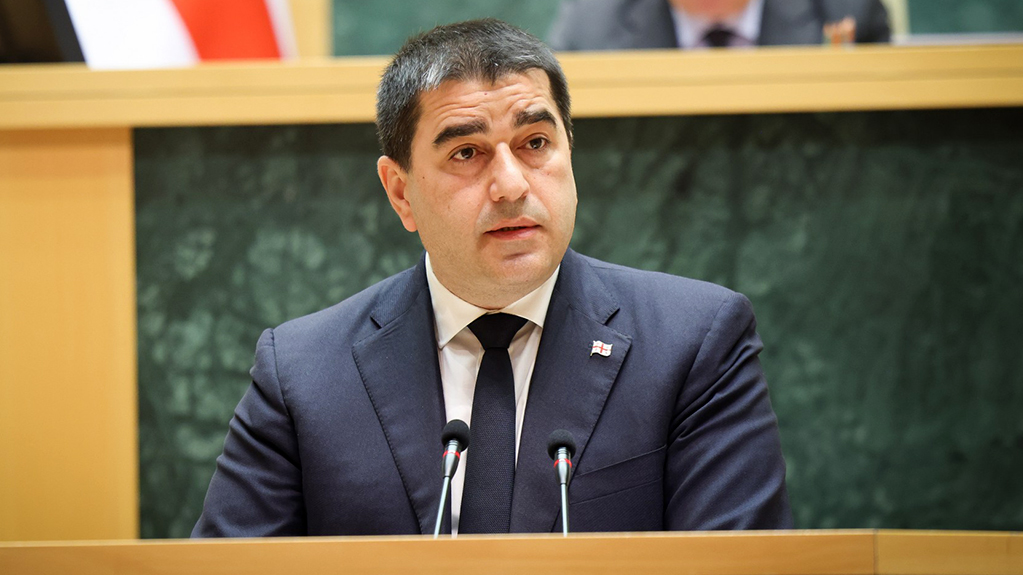
The Georgian Dream parliament approved further legislative amendments restricting the freedom of assembly on the third and final reading. The amendments were approved with 79 votes in favour and 9 against.
News





According to amendments to the Law on Assemblies and Demonstrations, it is prohibited to artificially block public transportation routes, and it is mandatory to notify the Ministry of Internal Affairs in advance if a demonstration takes place in a location where people move.
The notice must be submitted to the Patrol Police Department of the Ministry of Internal Affairs no later than 5 days before the organising and holding of each assembly or demonstration. In the case of a spontaneous assembly/demonstration, “the application must be submitted immediately, within a reasonable period of time, after the person responsible for the organisation of the assembly or demonstration becomes aware of the information about the organisation/holding of the spontaneous assembly/demonstration.”
The Ministry of Internal Affairs is authorised to issue a mandatory instruction regarding an alternative time and/or place for holding a gathering or demonstration, as well as an alternative route for a march. The instruction may be challenged in court; however, this does not suspend its effect.
“If individuals do not agree to the offer by the Ministry of Internal Affairs and continue to gather in a location where human rights and freedoms are violated, they will be held accountable, with administrative detention of up to 15 days for the first offence, and up to one year under criminal procedure for repeat offences”, stated Archil Gorduladze, one of the authors of the amendments.
In the event of a large-scale obstruction of transport or pedestrian areas in violation of these rules, the Ministry of Internal Affairs will issue a warning. If the area is not cleared within 15 minutes, the assembly will be declared unlawful, a decision will be taken to terminate it, and measures permitted under international law and Georgian legislation may be applied.
Nevertheless, giving a demonstrator 15 minutes “does not mean that if that participant stops violating the law during those 15 minutes, they have not committed that violation.”
Violation of the law will result in administrative detention for up to 15 days, with the confiscation of the item involved in the offence. If the offender is the organiser, detention may last up to 20 days with confiscation of the item. Engaging in the same act by someone already convicted will lead to criminal liability, with imprisonment for up to one year.
According to the Georgian Young Lawyers’ Association (GYLA), the aforementioned legislative amendments allow Georgian Dream to continue its unconstitutional attack on freedom of assembly and effectively abolish it.
Article 21, paragraph 1 of the Constitution of Georgia affirms the right to assemble freely without prior permission. Meanwhile, paragraph 2 permits establishing the need for prior notice. According to GYLA, it is crucial that this not be understood in a way that makes the exercise of freedom of assembly dependent on the state's de facto consent.
“Georgian Dream is attempting to establish a permission institution that is incompatible with the Constitution of Georgia, the European Convention on Human Rights, and the International Covenant on Civil and Political Rights.
It is noteworthy that “Georgian Dream” had already imposed permission requirements on the holding of assemblies and manifestations in closed public spaces. The new changes, effectively, leave no space in which assembly is not de facto subject to consent, and they deprive people of the opportunity to choose the place of assembly themselves.
Furthermore, subjecting gatherings and demonstrations on the sidewalk to the same regulations that apply to the transportation areas, despite such gatherings causing minor disruption to the usual rhythm of public life, suggests that the goal of the restrictions is not to protect the rights of others or maintain public order, but to create unjustified obstacles to assemblies/demonstrations”, stated in the GYLA report.
The human rights organisation notes that the aforementioned legislative amendments are part of an authoritarian pattern of lawmaking. In 2024-2025, several changes were made to the norms governing assemblies and demonstrations, sanctions were increased, and new grounds for administrative and criminal liability emerged. These amendments were criticised by international institutions, including the Venice Commission and the OSCE/ODIHR.